
Russian exiles stage fresh take on classic play in U.S.
Clip: 5/19/2026 | 7m 34sVideo has Closed Captions
Russians who fled after Ukraine invasion stage fresh take on classic play in U.S.
Two Russians who left their country after the invasion of Ukraine and are now rebuilding their lives and careers in the U.S. Senior Arts Correspondent Jeffrey Brown reports on a recent production in New York for our Art in Action series, exploring how art and democracy shape one another, as part of our CANVAS coverage.
Problems playing video? | Closed Captioning Feedback
Problems playing video? | Closed Captioning Feedback
Major corporate funding for the PBS News Hour is provided by BDO, BNSF, Consumer Cellular, American Cruise Lines, and Raymond James. Funding for the PBS NewsHour Weekend is provided by...
Russian exiles stage fresh take on classic play in U.S.
Clip: 5/19/2026 | 7m 34sVideo has Closed Captions
Two Russians who left their country after the invasion of Ukraine and are now rebuilding their lives and careers in the U.S. Senior Arts Correspondent Jeffrey Brown reports on a recent production in New York for our Art in Action series, exploring how art and democracy shape one another, as part of our CANVAS coverage.
Problems playing video? | Closed Captioning Feedback
Where to Watch PBS News Hour
PBS News Hour is available to stream on pbs.org and the PBS app.
Providing Support for PBS.org
Learn Moreabout PBS online sponsorshipGEOFF BENNETT: Now a different kind of migration story, one involving theater and two Russians who left their country after the invasion of Ukraine and are now rebuilding their lives and careers in the U.S.
Senior arts correspondent Jeffrey Brown reports on a recent production in New York for our Art in Action series exploring how art and democracy shape one another as part of our Canvas coverage.
JEFFREY BROWN: It's a play within a play, with cabaret humor, even slapstick, alongside the drama of loss of friends, family and country.
ALEXANDER MOLOCHNIKOV, Creator and Director, "Seagull: True Story": And I'm very thankful to all of you for allowing me to tell the personal, sometimes even dramatic story in a playful way.
JEFFREY BROWN: For Alexander Molochnikov, the creator and director of "Seagull: True Story," this is personal.
It's based on his own story.
What did you most want to bring out in this play?
ALEXANDER MOLOCHNIKOV: I think the value of art, the value of art as air and water for some people, and not only for people who make it, but sometimes for people who watch it.
With choosing between food and art, anybody would choose food if we are dying of hunger.
But, for me, I literally realized through this experience how, without doing theater, I start kind of dying inside.
JEFFREY BROWN: "Seagull: True Story," recently at New York's Public Theater, plays off Anton Chekhov's classic "The Seagull" and tells of a young Russian theater director named Kon, Molochnikov's alter ego, about to achieve his dream of directing a play at the world-renowned Moscow Art Theater, when a very different kind of drama intervenes, Russia's invasion of Ukraine in February 2022.
ALEXANDER MOLOCHNIKOV: In the beginning, you don't think it's forever.
Or maybe some people understood.
I didn't.
JEFFREY BROWN: Four years later, Molochnikov, who in his 20s had already directed productions at leading Moscow theaters, including the Bolshoi... MAN: Happy birthday!
JEFFREY BROWN: ... celebrated his 34th birthday with the cast of "Seagull" in New York, where he now lives and works.
ALEXANDER MOLOCHNIKOV: Oh, wow.
WOMAN: Make a wish.
SOFIA KAPKOV, Producer, "Seagull: True Story": I had a team of 40 people who was working for me.
I signed all documents and I left.
JEFFREY BROWN: Also a new New Yorker, the producer of "Seagull: True Story," 47-year-old Sofia Kapkov.
SOFIA KAPKOV: I came here without any plan, so I stayed with my friend.
I told him I'm going to be there for a week.
I ended up for a month.
And then after a month, I realized that's it.
That life is gone.
JEFFREY BROWN: That former life included heading her own production company that put on prominent contemporary theater and dance performances in Russia and abroad, not overtly political art, but she says a form of activism nonetheless.
SOFIA KAPKOV: I wanted to open this window to the freedom to show them, OK, now the world exists.
There is different type of art, for example, or different forms of art.
And in a way, this is my type of activism to show something that is relevant, that it's timely.
JEFFREY BROWN: Russia's invasion of Ukraine ended that.
She left within days, taking her two younger children, joining an older daughter who was studying at NYU.
SOFIA KAPKOV: I had a nice life back then.
I had a comfortable life.
I have home, friends, projects, successful business.
But I had my doubts in my country.
I woke up in the reality that we are killing our neighbors.
For me, it was obvious I need to live for the sake of my kids.
I don't want them to get used to the idea that war is normal.
And it's a very hard decision, because you're not just changing your life from one comfortable life to less comfortable.
You're changing the destiny of your kids.
It's a very big responsibility.
JEFFREY BROWN: Huge changes, big struggles documented in a memoir titled "Arts Hustler: A Story of Resilience," along with some advantages, including having international experience and contacts.
And within two years, she had co-produced "Our Class," a play set in Poland during World War II about neighbors turning on neighbors.
It had successful runs in New York, Boston, and most recently San Francisco.
In prewar Moscow, Alexander Molochnikov had demonstrated in support of prominent Russian dissident and opposition leader Alexei Navalny.
And after the invasion of Ukraine, he registered his protest with a series of anti-war posts on social media and danced to Ukrainian music in the Russian version of "Dancing With the Stars."
His name was taken off production credits and he says he received death threats.
In August 2022, he left Russia, enrolling in a graduate film course at Columbia University.
From that came a short film titled "Extremist" based on the true story of a young Russian woman whose public protest of the Ukraine war, putting anti-war and anti-Putin messages on grocery items, led to her imprisonment.
The film would win various international awards and was also short-listed for an Academy Award for best live-action short.
Today, Molochnikov can see the positive impact of the upheaval he went through.
ALEXANDER MOLOCHNIKOV: Because collapse motivates you to rebuild and really develop as a person.
I didn't really want it to happen again.
We just, like, built something here.
I would love a few more years to build more.
But the feeling of apocalypse -- and, of course, I want to say that, like, this my little art apocalypse is nothing compared to what people lost in Ukraine.
But, still, you lose your career that you've been building for 10 years.
It's healthy sometimes to lose it.
JEFFREY BROWN: The second half of "Seagull: True Story" is partly based on Molochnikov's experience after coming to the U.S., including the overt commercialism of the theater world here and what he says were different kinds of restrictions on language and expression he encountered.
And the play includes a moment amid the crackdown in Russia in which one character asked the American audience: ACTOR: And something like could never happen in America, right?
ACTOR: Right?
ALEXANDER MOLOCHNIKOV: Right?
And there's always -- it's interesting.
It's not a laugh.
it's not a clap.
Everyone's like, oh.
SOFIA KAPKOV: It just is a concern.
ALEXANDER MOLOCHNIKOV: I hope that that this play, maybe not in everyone, but in somebody, it would leave some thought or some concern about what's going on in the U.S.
today, and I hear it a lot.
And many people who saw it a year ago, now they're like, wow, this is about Iran now.
JEFFREY BROWN: Molochnikov and Kapkov say New York is their home now.
Both have become U.S.
citizens and aim to further build lives here with their artistic work leading the way.
SOFIA KAPKOV: Theater is very similar to democracy.
It should be a free space.
There are people allowed to ask any questions.
I believe in democracy, and I love this country, and I have hope for America.
I'm American now, right?
I don't have any hope for Russia, unfortunately.
And what Putin did, he destroyed life of many generations.
I don't like a lot of stuff that's going on here in America, but America is even younger than the Bolshoi Theatre in Moscow.
JEFFREY BROWN: America, the country.
SOFIA KAPKOV: America, the country, United States.
JEFFREY BROWN: Good perspective from the theater world to today's political realities.
For the "PBS News Hour," I'm Jeffrey Brown in New York.

Ada Ferrer reflects on family history, forces shaping Cuba
Video has Closed Captions
Ada Ferrer reflects on family history and forces shaping Cuba and the U.S. in new memoir (8m 49s)

Degree in three: More colleges speed up graduation timelines
Video has Closed Captions
Degree in three: Why more colleges are speeding up graduation timelines (8m 14s)
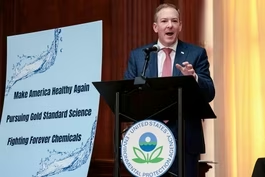
EPA moves to roll back limits on PFAS in drinking water
Video has Closed Captions
Trump administration moves to roll back limits on forever chemicals in drinking water (4m 48s)

Mosque attack heightens fears as anti-Islam rhetoric rises
Video has Closed Captions
San Diego mosque attack heightens fears as anti-Islam rhetoric rises in U.S. (9m)
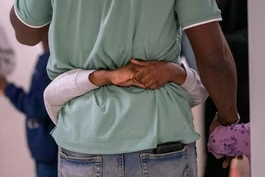
What happens to children when parents are detained by ICE
Video has Closed Captions
What happens to children when immigrant parents are detained by ICE (5m 49s)
Providing Support for PBS.org
Learn Moreabout PBS online sponsorship New Episode
- News and Public Affairs

Today's top journalists discuss Washington's current political events and public affairs.
 New Episode
- News and Public Affairs

FRONTLINE is investigative journalism that questions, explains and changes our world.

 New Episode
 New Episode
 New Episode
 New Episode

 New Episode
 New Episode
 New Episode
 New Episode
Support for PBS provided by:
Major corporate funding for the PBS News Hour is provided by BDO, BNSF, Consumer Cellular, American Cruise Lines, and Raymond James. Funding for the PBS NewsHour Weekend is provided by...