Here and Now
Here & Now for May 15, 2026
Season 2400 Episode 2444 | 26m 46sVideo has Closed Captions
Watch the entire episode of Here & Now for May 15.
Watch the entire episode of Here & Now for May 15.
Problems playing video? | Closed Captioning Feedback
Problems playing video? | Closed Captioning Feedback
Here and Now is a local public television program presented by PBS Wisconsin
Here and Now
Here & Now for May 15, 2026
Season 2400 Episode 2444 | 26m 46sVideo has Closed Captions
Watch the entire episode of Here & Now for May 15.
Problems playing video? | Closed Captioning Feedback
How to Watch Here and Now
Here and Now is available to stream on pbs.org and the free PBS App, available on iPhone, Apple TV, Android TV, Android smartphones, Amazon Fire TV, Amazon Fire Tablet, Roku, Samsung Smart TV, LG TV, and Vizio.
Providing Support for PBS.org
Learn Moreabout PBS online sponsorship>> The following program is a PBS Wisconsin original production.
>> Whiplash at the Capitol.
This week as a Republican candidate for governor.
Whip Democratic votes to kill a bipartisan bill.
[MUSIC] And with warmer temps and more ticks, cases of Lyme disease are on the rise.
[MUSIC] I'm Frederica Freyberg.
Tonight on "Here& Now", a full breakdown of the political mashup that held more drama than results.
And we hear from the bills, cheerleaders and challengers.
[MUSIC] infections has physicians cautioning for education and prevention.
It's "Here& Now" for May 15th.
[MUSIC] >> Funding for Here and Now is provided by the Focus Fund for Journalism and Friends of PBS Wisconsin.
>> A deal that made strange bedfellows of Republican candidate for governor Tom Tiffany and Democratic state lawmakers fell apart this week.
Governor Tony Evers and Republican legislative leaders had negotiated a $1.8 billion spending package that sent $600 million more to K-12 schools, including half of that for special education.
The spending designed to lower property taxes.
It also eliminated taxes on tips and overtime, and gave $850 million of the state's projected $2.5 billion budget surplus, directly back to income taxpayers, in the form of $300 checks to singles and $600 for married filers.
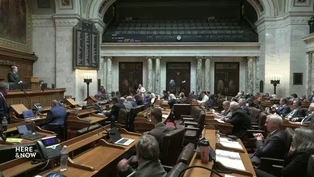
But when it went to the full legislature, the state Senate voted it down with three Republicans and all Democrats rejecting the plan.
Tom Tiffany had come out earlier lambasting the measure, calling it an Evers backroom deal, saying it's, quote, another Madison gimmick that fails to deliver lasting tax relief for Wisconsin taxpayers that put him in sync with Democrats like Senator Mark Spreitzer.
>> This is money that is simply not targeted to those who are actually hurting in this economy.
And with a price tag that we simply don't have the money to actually fund.
>> For his part, Governor Evers torched Tiffany, saying he purportedly made phone calls to help tank the deal and that needed investments and tax reductions wouldn't happen because some Republicans and Democrats would, quote, rather do what's best for the next election than what's right for the people of our state.
Of those who voted no, many didn't care for the fact the package was hatched by leaders not running for reelection and a lame duck governor also not running.
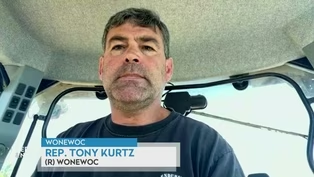
The bill saw bipartisan passage in the state Assembly, with ten Dems voting in favor, along with all Republicans, among them Republican Representative Toni Kurz of Wonewoc, vice chair of the Joint Finance Committee.
He joins us now.
And thanks a lot for being here.
>> Oh my pleasure.
Thank you for having me.
>> So how surprised were you that this blew up and failed?
>> I was incredibly shocked.
I'm actually you know, we're how many days after the fact and I'm still I'm still a little shocked and dismayed, to be very, very frank with you.
>> Why?
>> I just think it's a good package.
Really?
Since January, we've been working with the governor in good faith on this.
So for those that say this was done out of the blue, that is not true.
This is something that we've been working on.
And anybody inside the Madison bubble know we've been working on that.
That's what kind of shocks me the most that we couldn't get this across the finish line, even though people knew we were working on this personally.
And I'm just speaking for me.
I hope the governor calls us back in for a special session.
I really do.
>> On this or other matters.
>> On this particular matter.
I mean, what what bothers me the most about this entire package is, you know, you have some of my Republican colleagues that, you know, obviously, you know, they want to save the money for a large tax cut next year.
Okay.
That's fine.
And then you have my Democrat colleagues that obviously want to save all this money for next session because, you know, they they have their various programs that they want to do.
The problem is people are hurting right now.
And the further we keep pushing this down, the down the road is we're another year behind.
pot sweeteners that were going back and forth?
>> The property tax exemption for disabled veterans, that was part of a sweetener.
That is something incredibly important to those organizations.
We thought that was going to help disaster relief.
That is something that and that's had broad bipartisan support as well.
You know, in my area, we had just had some tornadoes a couple of weeks ago, you know, up in the Wausau area, in the Milwaukee area, the flooding last year.
So we thought that was a way to, to sweeten the pot.
But once again, this is this is an opportunity for them to come back to us and say, hey, we'd like to maybe see this.
Or I'd like to say that they wouldn't even entertain that.
That's what's kind of frustrating about the whole thing.
We got to the point where, you know, they didn't even want to sit down and talk in a reasonable way.
>> Just coming back around on this a bit.
Tom Tiffany also called the measures in this temporary gimmicks.
What about that?
>> I don't know, tax on tips and no tax on overtime as a gimmick.
I, I, I respectfully disagree with that.
You know the the special education funding once again that that is and if you want anybody to blame in like the state legislature on who really is a hawk on, on the special ed, it's me because as you know from your experience, once we put money into special education funding, regardless of what the economy does, that is money we as a state can never pull back because we have a federal requirement.
Once we put a dollar amount in special education, it has to stay there.
We can never claw that back if we have another horrible economy.
So I am a little careful on what we do for special ed.
Do we need to do it?
Absolutely.
And so to say that's a gimmick.
Once again, I respectfully disagree with that.
That's permanent funding for our schools.
So I, I disagree on on the premise on both of those.
>> So as to the economy, some people wanted to be prudent, hold on to any projected surplus in case it sours, you know, potentially more than it has.
What about that persuasion?
>> You know, I, I've heard that that's an argument some have tried to make.
The fact of the matter is, we had a really good state budget coming out of the state budget late fall.
We saw our projection numbers higher than anticipated just in January.
You know, the numbers really like our economy is doing better than we anticipated, even on Monday.
You know, Monday, the fiscal Bureau and wonderful Bob Lang and his incredible team over there came out with another.
It's going to be another $300 million that we are above projections.
So I would never.
And let me repeat this, I would never sign or vote on a bill if I knew that was going to put us in financial peril.
That's not the way we've been doing budgeting over the last 4 or 5 budgets.
We live within our means, and this budget and the proposal that unfortunately failed Wednesday night lives within our means.
Once again, people think about if this was all said and done, we'd still probably will well over have probably nine 800 to 900 million $1 million in our checking account.
But then a lot of people don't forget about the rainy day fund.
Rainy day fund is like our savings account, and that's well over $2 billion and that's earning interest.
It's almost $7.5 million a month just in interest.
So financially, the state is doing very well.
And I would never once again, I never would put any of that in jeopardy if there was a question about if we could not afford this or not.
>> Representative Tony Kurtz, thank you very much for joining us.
>> Hey, thank you for your time.
I hope you have a good, good weekend.
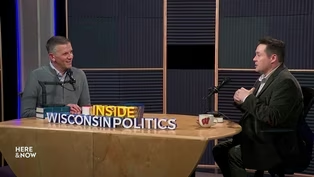
help us better understand the broader motivations and implications of this deal, we turn to our reporters at Inside Wisconsin Politics Zac Schultz of PBS Wisconsin and Shawn Johnson and Rich Kremer from Wisconsin Public Radio.
>> To me, this is a political Rorschach test.
How you view this particular deal kind of matches your view on politics for some people and for a lot of ordinary people around the state, this was the epitome of a compromise.
And as we're about to run for election, those are things that normally you'd want to see politicians pass.
The other side of that test is political purity.
And there are a lot of people looking at this deal saying, this isn't as good as I would like it to be, and I think we can do better when we have more power next year.
>> We had a very unusual scene kind of play out.
The assembly met after waiting all day to see what the Senate was going to do.
They passed this bill in short order.
The Senate is meeting at the same time, and it's clear that things are not going well there.
And this bill actually fails on a vote of 15 to 18.
And I know people probably think big deal things pass, things fail.
Bills don't actually get to the point of failure hardly ever in the state legislature.
If it doesn't have the votes, it does not come to the floor, especially something as big and dramatic as this.
And for the governor to negotiate this and his Senate Democrats stand unified against it to help kill it with a few Republicans is something we do not see every day.
Zac, what do you think was motivating Senate Democrats here?
>> There's two factors.
I think.
First is they were insulted.
They were left out of the loop.
>> That is huge, actually.
>> That everyone knows they need at least a couple Democratic votes and probably more so.
The fact that they were not consulted did not have any input on this bill, and made it clear from the very first time it was announced that they were unhappy with it, showed the second part of why Senate Democrats were not in line with this comes next fall.
And that's what the reelection there.
They are not quite certain, but very confident that they're going to flip the majority in that chamber and that when they come to power in the next session, they will not only have a say, they will be the deciding factors in how any bills are passed and how budgets are passed, and so they can direct where that money goes.
And if they think they get lucky and there's a Democratic assembly, then they're going to say, all this money will be available for us to spend in ways that we prefer instead of having to compromise.
clear cut case where circumstances matter completely.
You know, if if Tony Evers were running for election in November and he said, this is my big bill, Democrats, this is what I want to run on.
I mean, they would have voted.
They would have voted yes.
No.
Republicans probably wouldn't have brought it up in that case.
So, you know, it's a it's a theoretical exercise.
But but Senate Democrats, I'm confident, would have been with him.
He is not on the ballot, though, this November, as Diane Hesselbein noted, and Senate Democrats are poised to.
They think, take that majority.
She has essentially been a co majority leader on some of the big bills that have come through the Senate this year, from the budget to gambling.
And so to freeze them out of talks like this, which is the way they viewed it, certainly, and to end up with a bill that was pretty Republican in nature, about a billion and a half in tax cuts, was not something that they enjoyed, you know.
>> Well.
And don't forget, there is another factor when it comes to everyone looking at the next budget and the next year.
And that is there's a lot of people who think we may be looking into a recession.
Yeah.
So most of this surplus is a projection of what the economy is going to bring in for tax revenues.
If there's an economic downturn in the next six months, that money disappears all by itself without having been sent out.
So you send it out.
Even though most of this is one time spending, it may not be there next year.
Now, they say even in the worst of circumstances, at least the state will have a little bit money to start the next year with.
So that is a legitimate concern considering where gas prices and grocery prices are right now.
And with no end to a war in Iran, that the economy could shift and go down and these tax revenues may not materialize.
>> Rich, one question I had for you that we kind of traded notes on throughout the night was, will voters actually remember this?
Like, will anybody be rewarded or punished?
>> You know, it's it's a huge question.
You all of what you're saying makes sense to me, someone who's been really following this.
But, you know, I also remember being at a Supreme Court election night event and a fellow at the hotel not knowing there was an election that day.
So there's a part of me I'm always skeptical that this sort of thing will stick in voters mind.
It's different, I guess, if you're getting your door knocked consistently and people are reminding you of that, or if you see a lot of commercials.
But, you know, in the grand scheme of things, a $300, $600 check, that's a big deal.
But, you know, all the political infighting and everything like that, I just I'm not sure if people will carry that all the way to November.
>> A provision in the spending package would have given $50 million in state aid to Wisconsin technical colleges, the aim being to reduce the burden on local property taxes.
Technical colleges across the state serve 300,000 students on 16 campuses.
Leaders of the system report being underfunded by the state and didn't like the provision, as it would replace locally controlled funding with state controlled aid.
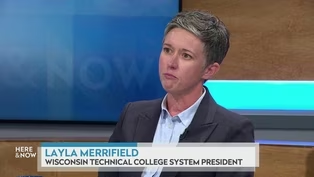
Wisconsin Technical College System President Layla Merrifield joins us with more.
Thanks for being here.
Thank you.
So describe to us how getting $50 million from the state is not a good thing in your mind, right?
>> Technical colleges are local units of government, and we have always been a state and local partnership.
So we think both local funding and state funding are both important.
However, we would like to hang on to the remaining property tax levy that we have access to.
It has been capped by the legislature, so rising.
We are not the cause of rising property taxes here.
The.
The issues are.
>> That being.
>> That being other local units of government.
And certainly we know that we have K-12 funding issues in in Wisconsin that probably need to be addressed.
>> So in the last budget, you saw additional state funding, but it came in $36 million.
I think less than you requested.
Is that an example of the uncertainty kind of of state aid?
>> That's exactly it.
We have not competed very well in recent state budgets for lawmakers attention and their priorities.
And because of that, we have come to really think about property taxes as as ballast in our in our budget.
It's a relatively small portion, maybe about 28% of our overall budget.
But it's an important portion that stabilizes our budgets and keeps things reliable, flexible, and allows us to really be responsive when local communities come to us for help.
>> So when you when you looked at the numbers, where would it have left the system?
If the 50 million in state aid offset would have passed.
>> It would have been about 10% of our overall levy that that went away.
But bear in mind that our property taxes in the technical college system are only around 3.5% of the total property tax burden here in Wisconsin.
So it's just not very much money.
But it's a big deal to us to have flexible dollars that we can direct where communities are asking for help.
>> Were you surprised about this provision?
>> Surprised?
No.
This has been an ongoing conversation in Wisconsin.
It's certainly something that we talk with our policymakers often about and try to make the case that local funding is important for our system, and that community and technical colleges continue to make decisions in the towns and counties where they are most affected, and that we're able to respond when, again, there's maybe a factory that closes and a lot of Wisconsinites are laid off, or even when we have shortages of firefighters and EMTs, things like that, which we're experiencing right now in our rural areas.
>> Did it hurt you to think that potentially state lawmakers and the governor didn't appreciate what you're talking about there?
>> Well, I think it's an ongoing conversation.
They are certainly familiar with my side of things, and they have their own points of view.
But we'll we'll get to a compromise position eventually, I'm sure.
>> What challenges do state tech colleges have right now?
>> Waiting lists and a lack of resources are are the main things that are on my mind and that keep me up at night.
We have thousands of students who are waiting to get into high demand, high paying fields.
And on the other side of that equation, we have employers who are looking for our graduates.
So we would like to put those two people together and and make sure that we can move more Wisconsin students toward those careers and pathways that are so important to maintaining, for example, our manufacturing industry in this state, our health care industry in this state, and really maintaining Wisconsin's quality of life.
>> What are those high demand fields?
>> There are many right now.
Dental hygiene is one.
We have long waiting lists and we are hoping to grow, continue to grow cohorts there.
We recently saw a one time funding infusion for that for that particular field.
But we need ongoing revenue to make that happen.
We are also seeing ongoing demand from manufacturers.
Again CNC machinists tool and die.
All sorts of advanced manufacturing fields that continue to be in demand.
We are also now seeing more demand from manufacturers to integrate AI into their automated processes.
So we know that we need to invest there, and we are seeking the resources to do that.
>> All right.
Very quickly, in the next state budget cycle, do you have concerns that they'll try to move more funding for tech colleges over to state aid?
>> Well, again, every state budget is different.
And in some ways, some of those conversations continue to to rise up.
So we will continue to engage with our policy makers and make sure that we do what's best for Wisconsin.
Merrifield, thanks very much.
>> In other news, with spring starting earlier and warmer weather lingering deeper into the fall, the tick season is expanding.
Wisconsin is already a hot spot for ticks in the U.S.
second in the nation after some locations on the East Coast.
And with the deer tick prevalent across the state, cases of Lyme disease are also on the rise, spiking already this month ahead of last year and 2024 marked a record of nearly 2500 Lyme disease cases in Wisconsin.
Could that be surpassed this year?
Researchers at Gundersen Medical Foundation are staying on top of the disease.
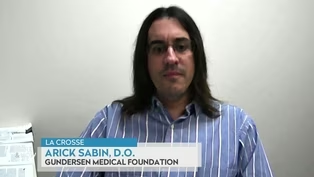
Doctor Eric Sabin leads the research there, and he joins us now.
Thanks for being here, doctor.
>> Happy to do it.
>> How alarming is it that the tick population is growing.
And with it cases of Lyme disease.
>> Well I think that it's it's not going away.
And I think that as a disease in our region, I think we should get pretty that it's a threat that will probably become more common over time, especially when you figure in changes to weather and how often people are outside doing outdoor recreation.
It seems like a thing that's going to be with us going into the future.
>> And so what should people do about that?
I know that you have said that, you know, prevention is better than a cure.
So what's the best prevention here?
>> Generally speaking, be aware that if you're going outside and you're going to be in a place where ticks might be, we know that if you remove these things from you before they've had a chance to attach for too long, the transmission risk of Lyme disease is very, very low or negligible.
So we recommend people be very vigilant to that sort of thing before they once they come back in from a recreational outing.
>> If you do a contract Lyme disease, is there a cure for it?
>> There are exceptional treatments.
We've been using antibiotics for a very, very long time.
Yes, people can be cured, but it's a pretty serious illness and a lot of folks and certainly has no no limits on its ability to produce misery and those who get it.
But yes, we can usually treat people very effectively, especially if we catch the disease early.
>> So what are some of the worst symptoms of it?
>> The ones that patients have told me are the most disturbing are the ones that involve the joints.
And I've had patients that have very significant problems with their mobility and very significant joint pain going into months, sometimes almost a year.
And for people who are otherwise real active or at a real active phase in their life, it can it can significantly disrupt their, major degree.
>> So does it matter if it is diagnosed and treated early versus later?
>> The way that the disease operates is that it produces inflammatory reactions in the human body that that have a tendency to progress, change, and worsen over the course of time if the infection is not treated.
Generally speaking, it's better if you take care of it sooner rather than later.
Lots of the cases don't get recognized until weeks or even months have elapsed, and at that point, the symptoms have oftentimes been much more dramatic.
But generally speaking, it's a good idea to try to get antibiotic treatment for people very soon, and they have a tendency not to then progress into the real serious joint or cardiac or neurological complications after that.
>> How would you know that that you had it early?
>> Well, there are certainly tests that we can use.
A lot of things in medicine depend on clinical context.
And so the it starts with somebody seeking care and bringing up the idea that they may have been outside or may have had tick bites or may have been exposed to ticks.
And then it relies on the part of the health care provider to recognize that it's in our area.
And it has a pretty diverse array of presentations.
And so you combine, you know, the right place at the right time kind of risk factor profile with the person presenting with the right And at that instance, you know, you take action, you can give people treatment.
A lot of times you can prevent things from getting much worse.
>> So has research developed good tests to diagnose Lyme disease?
>> I'm biased.
I think that the testing can work and can be effective in some circumstances, but it has a lot of limits by virtue of how it works.
Most of the present testing is based on immunological reactions through a process we call serology.
And there are pros and cons to that.
Those tests have advantages and that they can show us immunological reactivity and recognition, but they also can be very difficult to interpret.
They don't behave, so to speak, the way that a lot of other serological tests do, because it's a strange disease and we don't really have tests that I think are colloquially as well understood as something like a pregnancy test.
A pregnancy test doesn't leave much doubt about what the result means.
The problem with Lyme disease testing in current use is, is that it's just simply not that straightforward.
In a lot of cases, it can be ambiguous.
>> And so in that instance, if the results are ambiguous, should a patient ask to be treated anyway.
>> I would suggest that any patient have an individual discussion with their provider and make some decision making on what makes sense for the risk benefit.
Pros and cons you know scenario.
You should always be forthright with your doctors about what you know you think is going on.
And health care practitioners should be attentive and mindful of what patients might have experienced in medical school.
They told me, you can't diagnose what you don't think of.
And a lot of times things that are not being considered are diagnoses that can get missed or delayed.
>> Well, thank you for doing that work, doctor Sabin, thanks for joining us.
>> I appreciate it.
Thank you very much.
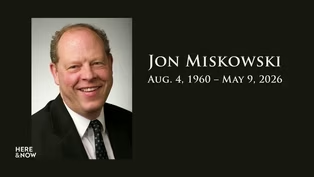
>> Finally tonight we relay the news with sadness that Jon Miskowski, our PBS Wisconsin director of television, has passed away following a long battle with cancer.
Jon Miskowski was director since 2015.
Originally from Stevens Point, he started his career here as a volunteer at a TV back in 1984.
John's vision brought many firsts to this station, including LS Lambeau welcoming home Wisconsin's Vietnam veterans.
>> I want to thank you from my heart.
>> Other initiatives John developed include.
PBS Wisconsin Education, Wisconsin Hometown Stories and Tribal Histories.
Upon his retirement earlier this month, John said, my 40 years in public television, including my time as PBS Wisconsin director of television, have been a source of inspiring challenges and creative joy from all of us here at PBS Wisconsin.
Thank you, John, for your leadership.
John is survived by his wife, two sons, and the light of his life.
His granddaughter, Jon Miskowski, was 65.
[MUSIC] life and legacy at PBS wisconsin.org.
That's our program for tonight.
I'm Frederica Freyberg.
Have a good weekend.
>> Funding for "Here& Now" is provided by the Focus is provided by the Focus Fund for Journalism and friends of PBS Wisconsin.
 New
NewDr. Arick Sabin on Rising Lyme Disease Cases in Wisconsin
Video has Closed Captions
Clip: S2400 Ep2444 | 5m 44s | Dr. Arick Sabin on Lyme disease cases with warmer weather extending the deer tick season. (5m 44s)
 New
NewHere & Now opening for May 15, 2026
Video has Closed Captions
Clip: S2400 Ep2444 | 1m | The introduction to the May 15, 2026 episode of Here & Now. (1m)
 New
NewInside Wisconsin Politics: A Failed Bipartisan Spending Deal
Video has Closed Captions
Clip: S2400 Ep2444 | 5m 3s | Inside Wisconsin Politics on the Legislature voting down a state budget surplus plan. (5m 3s)
 New
NewLayla Merrifield on Funding for Wisconsin Technical Colleges
Video has Closed Captions
Clip: S2400 Ep2444 | 5m 13s | Layla Merrifield on how a budget surplus deal would have provided aid to tech colleges. (5m 13s)
 New
NewThe Legacy of PBS Wisconsin Emeritus Director Jon Miskowski
Video has Closed Captions
Clip: S2400 Ep2444 | 1m 23s | Jon Miskowski, emeritus director of television for PBS Wisconsin, has passed away at 65. (1m 23s)
 New
NewRep. Tony Kurtz on Backing Wisconsin's Budget Surplus Plan
Video has Closed Captions
Clip: S2400 Ep2444 | 13m 11s | Tony Kurtz on negotiations for a bipartisan state budget surplus deal that failed to pass. (13m 11s)
 New
NewWisconsin's Bipartisan State Budget Surplus Deal Falls Apart
Video has Closed Captions
Clip: S2400 Ep2444 | 1m 52s | A bipartisan vote blocked a plan to boost school funds and send checks to taxpayers. (1m 52s)
Providing Support for PBS.org
Learn Moreabout PBS online sponsorship
- News and Public Affairs

Top journalists deliver compelling original analysis of the hour's headlines.

- News and Public Affairs

Today's top journalists discuss Washington's current political events and public affairs.












Support for PBS provided by:
Here and Now is a local public television program presented by PBS Wisconsin